Introduction
Accounting is the foundation of every successful business, yet the way financial records are managed has evolved dramatically over the years. Many small businesses still rely on manual accounting systems, such as spreadsheets, paper ledgers, or basic desktop software. While these methods were once standard practice, they are increasingly becoming inefficient in today’s fast-paced digital economy.
On the other hand, cloud-based accounting platforms like Xero are transforming how businesses manage their finances. With automation, real-time data access, and seamless integrations, cloud accounting is rapidly becoming the preferred choice for modern businesses.
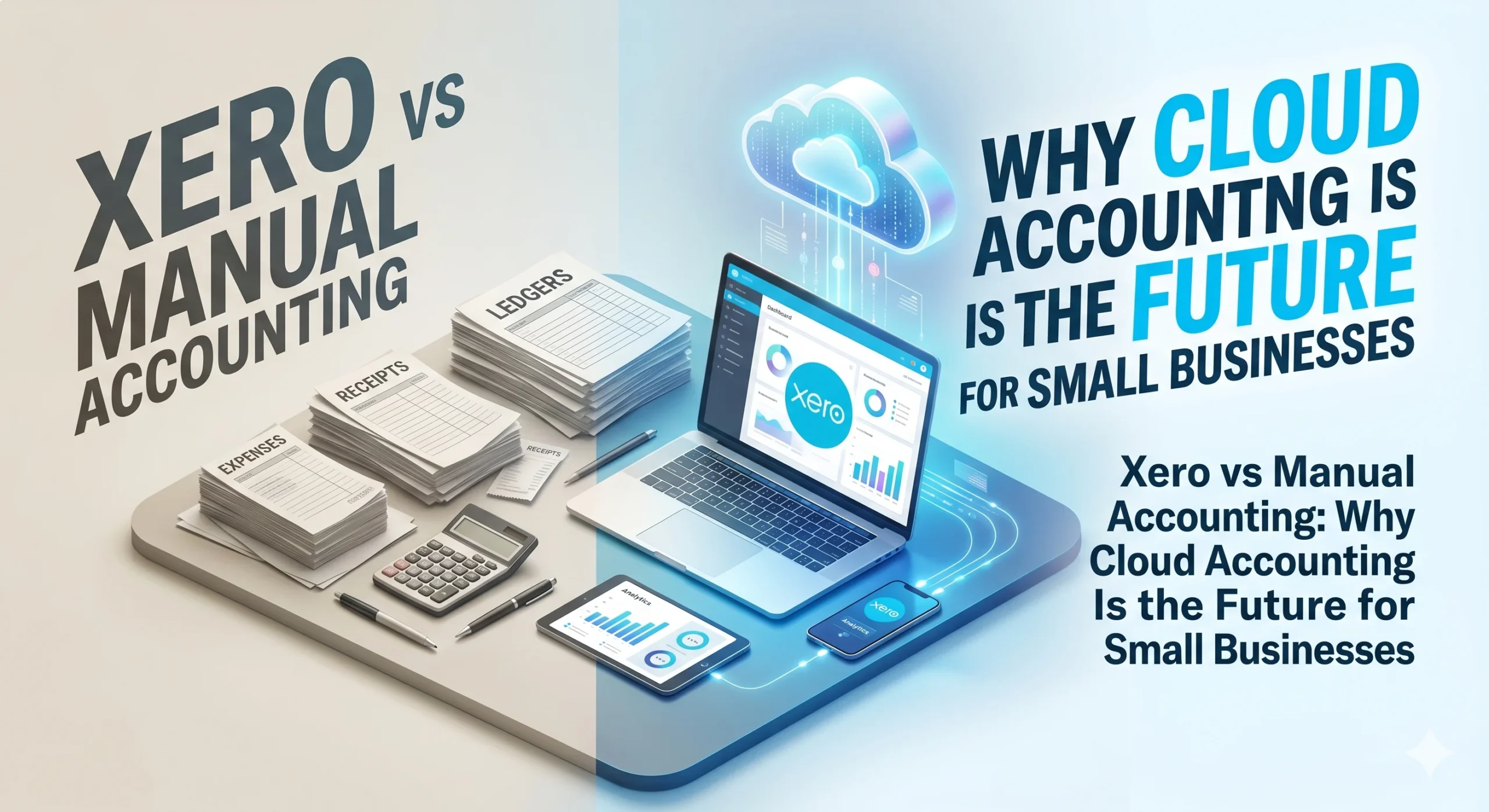
This article provides a comprehensive comparison between Xero and manual accounting, highlighting why cloud accounting is shaping the future of financial management for small businesses.
What Is Manual Accounting?
Manual accounting refers to the traditional method of recording financial transactions without automation or cloud-based systems. It typically involves:
- Paper-based ledger books
- Excel spreadsheets
- Physical invoice records
- Manual bank reconciliation
Key Characteristics of Manual Accounting:
- Human-driven data entry
- No real-time updates
- High dependency on manual calculations
- Physical storage of documents
While manual accounting is simple in concept, it becomes increasingly complex and error-prone as a business grows.
What Is Cloud Accounting with Xero?
Cloud accounting uses internet-based software to manage financial data in real time. Xero is one of the leading platforms in this space, offering a fully automated and connected financial system.
Key Features of Xero:
- Real-time financial reporting
- Automated bank feeds
- Cloud-based access from anywhere
- Invoice and expense automation
- Multi-user collaboration
- Integration with business apps
Unlike manual systems, Xero stores all financial data securely in the cloud, eliminating the need for physical records or local software installations.
Xero vs Manual Accounting: A Complete Comparison
Data Entry and Accuracy
Manual Accounting:
- Requires full manual data entry
- High risk of human errors
- Difficult to correct mistakes
Xero (Cloud Accounting):
- Automates transaction imports
- Reduces manual input
- Uses smart matching to minimize errors
Insight:
Manual systems depend heavily on human accuracy, while Xero significantly reduces the chance of errors through automation.
Real-Time Financial Insights
Manual Accounting:
- Financial data is often outdated
- Reports are prepared periodically (weekly/monthly)
- No instant visibility into cash flow
Xero:
- Provides real-time dashboards
- Updates transactions instantly
- Offers live cash flow tracking
Example:
A small retail store using Xero can instantly see daily sales performance, while manual systems may take days to update records.
Time Efficiency
Manual Accounting:
- Time-consuming bookkeeping
- Requires manual reconciliation
- Slow report generation
Xero:
- Automates repetitive tasks
- Speeds up reconciliation
- Generates reports instantly
Result:
Businesses save hours of administrative work every week.
Financial Reporting
Manual Accounting:
- Reports are created manually
- Higher risk of calculation errors
- Limited financial insights
Xero:
- Automated financial reports
- Profit and loss statements generated instantly
- Advanced analytics and forecasting tools
Cash Flow Management
Cash flow is critical for small business survival.
Manual Accounting:
- Hard to track real-time cash flow
- Delayed awareness of financial issues
Xero:
- Real-time cash flow dashboards
- Forecasting tools for future planning
- Alerts for overdue invoices
Accessibility and Collaboration
Manual Accounting:
- Limited to physical location or local files
- Difficult for multiple users to collaborate
Xero:
- Cloud-based access from anywhere
- Multiple users can work simultaneously
- Role-based permissions for security
Data Security
Manual Accounting:
- Risk of physical damage or loss
- No backup system unless manually created
Xero:
- Secure cloud storage
- Automatic backups
- Encrypted financial data
Scalability
Manual Accounting:
- Becomes unmanageable as business grows
- Requires more staff for bookkeeping
Xero:
- Easily scales with business growth
- Handles large transaction volumes
- Supports multi-branch operations
Why Cloud Accounting Is the Future
The shift toward cloud accounting is not just a trend—it is a structural transformation in how businesses operate financially.
Automation Is Replacing Manual Work
Modern businesses prefer systems that reduce repetitive tasks such as:
- Data entry
- Reconciliation
- Invoice processing
Xero automates these processes, allowing businesses to focus on growth instead of administration.
Remote Work Requires Cloud Access
With remote and hybrid work models becoming standard, businesses need systems that can be accessed anywhere.
Cloud accounting enables:
- Remote financial management
- Real-time collaboration
- Mobile access to financial data
Real-Time Decision Making
In competitive markets, decisions must be made quickly.
Cloud accounting provides:
- Instant financial insights
- Live reporting dashboards
- Better forecasting capabilities
Integration with Business Ecosystems
Modern businesses use multiple tools such as:
- Payment gateways
- CRM systems
- Inventory management software
Xero integrates all these systems into one financial ecosystem, eliminating data silos.
Reduced Operational Costs
Cloud accounting reduces costs by:
- Eliminating manual bookkeeping needs
- Reducing paper-based processes
- Minimizing accounting errors
Practical Use Cases of Xero in Small Businesses
E-Commerce Businesses
- Automatically sync online sales
- Track platform fees and expenses
- Manage multi-channel transactions
Service-Based Businesses
- Automate client invoicing
- Track project expenses
- Monitor profitability per client
Retail Businesses
- Manage inventory-related costs
- Reconcile daily sales automatically
- Track supplier payments
Freelancers and Startups
- Simple invoicing system
- Easy expense tracking
- Tax-ready financial records
Limitations of Manual Accounting
While still used in some small businesses, manual accounting has several limitations:
- High chance of human error
- Time-consuming processes
- No real-time insights
- Difficult scaling
- Poor collaboration capability
These limitations make it unsuitable for modern business environments.
Key Advantages of Xero Over Manual Accounting
- Automation of repetitive tasks
- Real-time financial visibility
- Improved accuracy and reliability
- Faster decision-making
- Stronger cash flow control
- Seamless scalability
The Future of Accounting: Fully Cloud-Based Systems
The future of accounting is clearly moving toward:
- AI-driven financial insights
- Fully automated bookkeeping
- Real-time global access
- Integrated financial ecosystems
Platforms like Xero are already leading this transformation by combining automation, cloud technology, and user-friendly design.
Conclusion
The comparison between Xero and manual accounting clearly highlights a significant shift in how businesses manage their finances. While manual accounting relies on time-consuming processes and is prone to errors, cloud accounting offers speed, accuracy, and real-time financial control.
Xero stands out as a powerful solution that not only simplifies bookkeeping but also enhances decision-making, improves cash flow management, and supports business scalability.
For small businesses aiming to stay competitive in a digital-first economy, adopting cloud accounting is no longer optional—it is a strategic necessity. The future of accounting is automated, connected, and cloud-driven, and businesses that embrace this shift will be better positioned for sustainable growth and financial success.